
India also called for crippling the illicit drug trade which provides financial sustenance to these terror outfits.

In an apparent resspone to India's aggressive counter-insurgency rhetoric, Pakistan's Army Chief General Raheel Sharif has warned that no one should dare to cast an evil eye on his country.

'Obama's decision to end the US military involvement in the Afghan civil war needs to be welcomed as a positive development for regional security and stability. India, too, has a great opportunity opening up here if it plays its cards in sync with the spirit of the times rather than continuing to view the Afghan problem in zero-sum terms,' says Ambassador M K Bhadrakumar.

Rediff.com reproduces the translation of the remarks made by President Ashraf Ghani at a press conference.

Sukanya Verma gives us a lowdown on all those wonderful movies she saw and movies you need to see as and when they arrive to a screen or streaming space near you.
'The greatest threat faced by India does not come from Pakistan, it comes from terrorism... It is easier to secure the borders of the US; it is not so easy to make India's borders secure,' Pulizer Prize-winning journalist Mark Mazzetti tells Rediff.com's Sanchari Bhattacharya.

'China is a friendly country and we welcome it for reconstruction and developing Afghanistan'

Afghanistan said Pak was diverting attention of the international community from its 'longstanding failure' to take effective action against terrorist groups.
'The Pakistan army is trying to mainstream the LeT.'

The outcome of the Bangkok NSA-level talks underscores that Pakistan has got exactly what it wanted -- talks at different levels, talks on Kashmir, talks on mutual concerns regarding terrorism, talks on ceasefire on the border. What if any has been India's gains remains unexplained, says Ambassador M K Bhadrakumar.

Chinese Foreign Minister Wang Yi arrived in India Thursday evening in the highest-level visit between the two countries after the ties came under severe strain following the eastern Ladakh standoff nearly two years ago.

Beijing's political risks are also escalating because of a renewed wave of public anger in many parts of Balochistan against human rights abuses by Pakistani troops deployed to crush the low-intensity insurgency in the province, the report said.
'We think Pakistan has moved decisively against terrorists that threaten Pakistan internally, but still needs to devote attention to those that represent a threat to their neighbours.'

'There were assurances that Jaish-e-Mohammad was being reined in as was the Lashkar-e-Tayiba, but Pakistan's security forces could not risk opening too many dangerous new fronts,' notes former foreign secretary Ambassador Shyam Saran, who has just returned from a visit to Lahore.

Friday's incident at Herat has dampened somewhat the spirit behind the invitation. It reminds Modi much before he officially becomes prime minister, of the challenge that awaits his government, says Sheela Bhatt/Rediff.com

'Islamabad receives billions in aid from the US but continues to harbour terrorists,' he said.

'Perhaps the biggest indication was its striking decision in November to delink LeT from its aid certification process.' 'The administration decided that the US, in order to send military aid to Pakistan, would not need to certify that Pakistan is cracking down on LeT.' 'Perhaps the administration was trying to offer a carrot -- in effect, we're backing off on LeT, but in return we expect you (Pakistan) to go after the Haqqanis.' 'Either way, the optics were dreadful for the US given that Hafiz Saeed was released from house arrest a few days after the US move.' 'The US reacted angrily, but eventually it moved on, and refocused on its core concern: The Afghan-focused terror groups.'
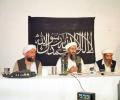
Al Qaeda's reclusive chief Ayman al-Zawahiri, who played a central role in the 9/11 terror attacks and later created the group's regional affiliate in the Indian subcontinent, was killed in a US drone strike in Afghanistan's Kabul, in the biggest blow to the global terror network since killing of its founder Osama bin Laden in 2011 in Pakistan.

Operation Radd-ul-Fasaad launched to fight terrorism across country.
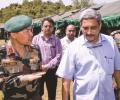
'China is likely to help Pakistan in keeping the fire burning in J&K to bleed India for its own interests.' A fascinating excerpt from Lieutenant General K Himalay Singh's Making of a General: A Himalayan Echo.

'There is a consensus within the Indian security establishment -- at least among those who draw their conclusions from data instead of speaking from nationalist sentiment -- that India lacks the offensive capability to defeat Pakistan in a short war.'

Most of the American military aid to Islamabad for counterinsurgency has gone into buying equipment to fight India, a former US diplomat has told lawmakers as he described Pakistan as a country which is "on the edge in many ways of being a failed state".

Colonel Anil Athale (retd) recalls how the Battle of Panipat, 258 years ago, changed the history of India for the next century and half.

United States President Barack Obama has announced that he will withdraw 33,000 Americans troops from Afghanistan by the summer of 2012, beginning with an initial drawdown of 10,000 surge forces by this year-end.

The Taliban's official spokesman, Abdulqahar Balkhi, claimed responsiblity for the attack on Twitter.

'When the Taliban took over there was a genuine fear that they will harm me, but right now that fear is not there.'

Sharif raises Kashmir issue at UNGA, renews plebiscite demand.

The number of people killed in acts of terror reached a record high last year, with almost four in five of these deaths occurring in just five countries, new research shows.
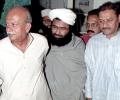
'The Pakistani move to ban militant outfits and placate international opinion and Islamabad's openness to a UN security council resolution on Azhar -- instead of beseeching China to cast yet another veto -- enables Islamabad to occupy the high ground,' notes Ambassador M K Bhadrakumar.

Pakistan's military can go to any length to inflict harm on India, so don't write off the possibility of an ISI-IS alliance, says Rajeev Sharma.
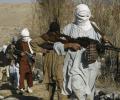
US intelligence agencies had been tracking the hostages and shared their location when they were shifted to Pakistan.
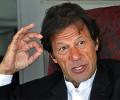
'We are the first government that has started disarming militant groups. This is the first time it's happening. We've taken over their institutes, their seminaries. We have administrators there'

There is growing acceptance of the idea in the international community that engaging the Taliban government is a far better approach than ostracising it, observes Ambassador M K Bhadrakumar.

'Here in Delhi, the Modi government is supposedly looking at 'options' to hit back at Pakistan in any whichever way it can, while in Washington, the Obama administration is looking for ways to strengthen US military cooperation with Pakistan,' says Ambassador M K Bhadrakumar.
'Who in Pakistan was intending to carry out one of the most grievous acts of international terrorism just a few months ago?' Former CIA official Bruce Riedel reveals how the Lashkar-e-Tayiba and the ISI planned the attack on the Indian consulate in the Afghan city of Herat in May to take Indian diplomats hostage and disrupt Narendra Modi's swearing-in.

'For its part, Pakistan often gives safe haven to agents of chaos, violence, and terror.'
.jpg)
The Indian Army must be given a free hand to retaliate punitively at one or more places of its choosing on the LoC. The aim should be to cause maximum damage to the forward posts of the Pakistan army, particularly those through which recent attacks have been launched, thereby raising the cost for the army, says Gurmeet Kanwal.

The relation between India and China has broad influence on Asia's security and the United States will continue to engage with them to encourage regional stability, the nominee for the Pentagon's top policy post for the Asia-Pacific region said.

'If India does venture across the LoC, it will evoke a strong response.'
A disparate global network of violent fundamentalist Islamic groups threatens India's eastern flank as much as the north and west with a real possibility of these spilling over into our borders, says Shyam Saran.
